Tips & Tricks
GEO vs SEO: Why Your Business Needs to Be Visible to AI, Not Just Google

by
Abhi Dave
•

Quick gut check: When was the last time you actually clicked through ten blue links on Google?
Be honest. For most of us, that habit is fading.
We ask ChatGPT. We ask Perplexity. We type a question into Google and read the AI Overview before touching a single link. Search is not disappearing, but it is changing shape.
Gartner predicts traditional search engine volume could drop by 25% by 2026 as AI chatbots and virtual agents become substitute answer engines. Adobe found AI-driven referral traffic grew more than 10x in the U.S. from July 2024 to February 2025. So no, this is not some future trend. It is already changing how people discover businesses.
ChatGPT is already handling 2.5 billion prompts a day globally. Google is still massive, with more than 5 trillion searches a year, but even Google is turning Search into a more AI-led answer experience.
That means the real battle is no longer only “Can people find you on Google?”
The new question is:
When an AI gives someone an answer, does your business get mentioned?
This is the story of GEO (Generative Engine Optimization) and why it may become one of the most important visibility channels for modern businesses.
Wait, What Even Is GEO?
SEO (Search Engine Optimization) was always about one goal: rank high enough on Google that a human clicks your link.
GEO (Generative Engine Optimization) has a different goal entirely: get mentioned inside the answer itself, so the AI recommends you before the human ever needs to click anything.
Think of it like this. SEO is trying to get your restaurant onto the map. GEO is trying to get your restaurant to be the one the AI tour guide actually recommends when someone asks "where should I eat tonight."
One gets you visibility. The other gets you the actual invite.
Quick Side Note: What About AEO?
You may also hear another term in this space: AEO, or Answer Engine Optimization.
Here’s the easiest way to understand it.
If someone asks AI, “What is GEO?” and the AI uses a blog like this one to explain the answer, that is AEO. Your content helped answer the question.
But if someone asks, “Who can help my business show up in AI recommendations?” and the AI mentions a company as one of the options, that is GEO. The business became part of the shortlist.
Simple difference:
AEO gets your explanation into the answer.
GEO gets your business into the shortlist.
They overlap, of course. Clear answers help AI understand and trust you better. But GEO goes one step further because it is not just about being useful information. It is about becoming one of the names AI is confident enough to recommend.
We will talk about AEO separately soon. For now, this blog is about GEO because GEO is where discovery turns into recommendation.
The Shift Nobody Sent a Memo About
Here’s the uncomfortable part: It is happening everywhere.
People are not just typing “best option near me” into Google and clicking through ten tabs anymore. They are asking AI to shortlist the options for them.
“Best cafes near me for a quiet client meeting.”
“Reliable packaging manufacturers for a small food brand.”
“Best preschool near me with good reviews.”
“Which restaurant is good for a family dinner tonight?”
“Best accounting firm for a small business.”
And instead of getting a page full of links, they get a shortlist.
Three names. Maybe five. Instantly.
That is the shift.
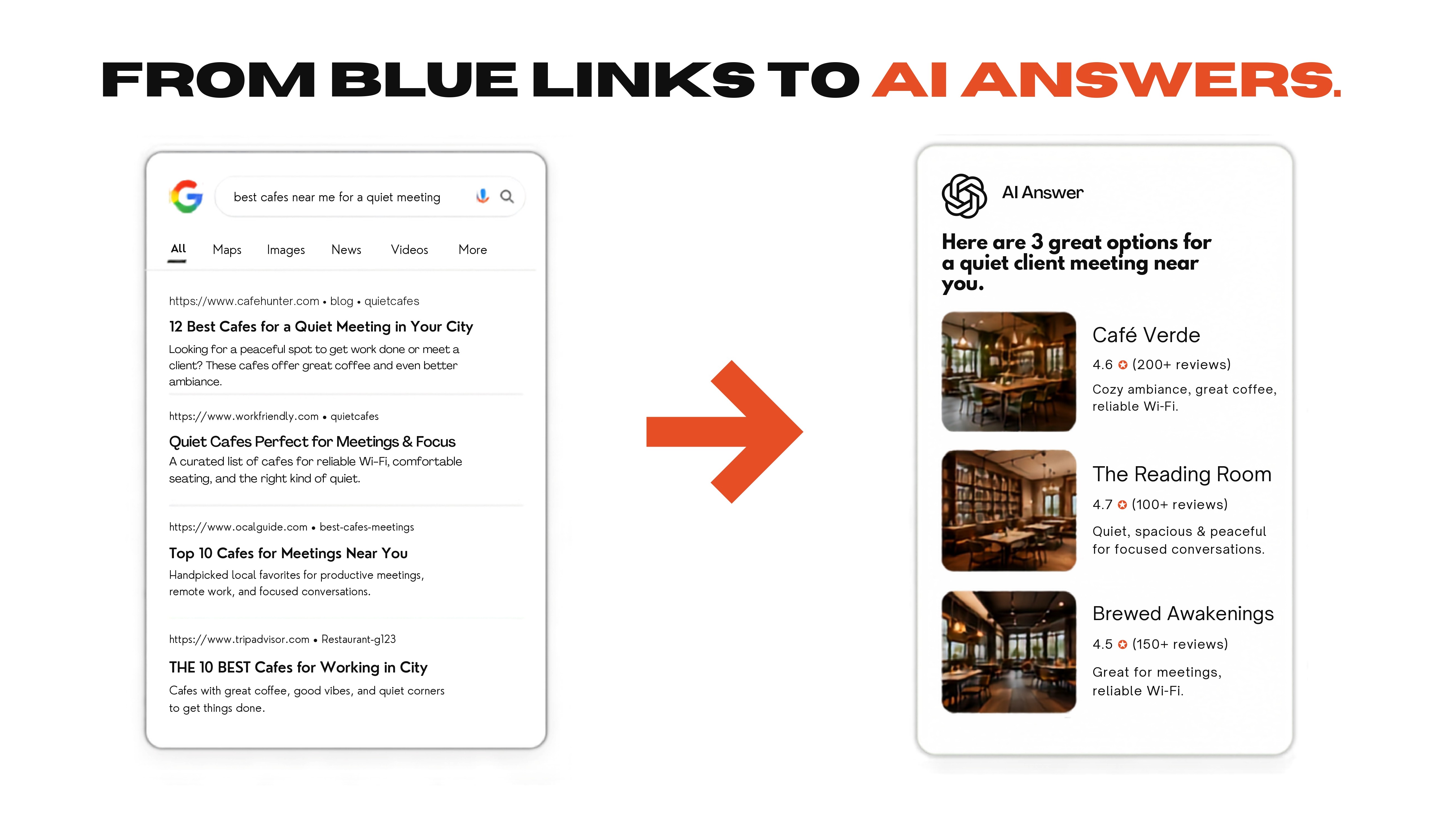
Earlier, your customer would search on Google, open your website, check reviews, compare options, and then decide. Now, AI may do the first round of filtering before your customer ever sees your website.
If your business isn't one of those three names, you didn't lose the sale. You never even entered the room.
The New Customer Journey
The old customer journey looked something like this:
Search Google → Open five websites → Compare options → Read reviews → Shortlist → Contact
The new journey is starting to look very different:
Ask AI → Get three recommended options → Verify quickly → Contact one or two
That is a massive change.
In the old journey, your website was part of the discovery process. In the new journey, your website may only be seen after AI has already decided whether you deserve to be in the shortlist.
This is why GEO matters. It is not just about getting traffic. It is about being recommended before the buyer even starts comparing.
The Plot Twist: SEO and GEO Aren't Actually Rivals
Here's where most people get it wrong. They think GEO is some brand new game with brand new rules, completely separate from SEO.
It's not. It's a sequel, not a reboot.
AI search tools do not all work the same way. ChatGPT, Gemini, Perplexity, Claude, and Google’s AI answers each use different combinations of models, search systems, indexes, live web sources, and trusted references.
But the practical lesson is the same: if your business is not clearly represented across the open web, AI systems have less reliable information to work with.
Your website, reviews, directories, third-party mentions, service pages, FAQs, and case studies all become trust signals.
So the real move is not “abandon SEO for GEO.”
SEO helps you become findable. GEO helps you become recommendable.
Or, put another way:
SEO gets you in the room. GEO gets you the mic.
What AI Looks For Before Recommending You
AI tools do not recommend businesses randomly. They look for signals that make your brand easy to understand, verify, and trust.
That usually means:
Clear website pages that explain what you do
Updated service or product information
Consistent business details across platforms
Reviews, testimonials, and third-party mentions
Directory listings in your industry
Case studies, FAQs, and comparison-friendly content
Fresh content that proves your business is active
Think of it like reputation, but structured for machines.
If ten different places on the internet clearly agree on who you are, what you offer, where you operate, and why people trust you, AI systems have more confidence including you in an answer.
If your information is vague, outdated, inconsistent, or only exists on your own website, you become harder to recommend.
Why This Actually Matters for Revenue (Not Just Vanity Metrics)
Here’s the part that should make any founder sit up straight: AI-referred traffic may be smaller today, but it can be extremely high-intent.
Why?
Because by the time someone clicks through from an AI answer, they are usually not casually browsing. The AI has already helped them compare, filter, and shortlist options. That means the visitor may arrive with more trust, more context, and less confusion.
Adobe reported that AI referrals are rapidly closing the gap with traditional channels in conversion rates and revenue per visit. So even if the volume is still early, the quality of that traffic is becoming very hard to ignore.
That is not just a vanity metric. That is the kind of discovery channel most businesses should start taking seriously now.
So How Do You Actually Get Cited?
No, you can't bribe ChatGPT 😁. No, there's no secret backdoor. But there are real, working patterns:
1. Write like you're answering a real question, not chasing a keyword.
AI answer systems are more likely to surface content that directly and clearly answers something a human would actually ask.
2. Structure matters more than ever.
Clear headings, direct answers, scannable sections. AI tools extract and summarize: messy, wall-of-text content just doesn't get picked up cleanly.
3. Be mentioned where AI already trusts.
Industry directories, review platforms, credible third-party mentions: these build the "multi-source agreement" that AI systems look for before confidently recommending a brand.
4. Keep things current.
AI search tools, especially ones like Perplexity, often favor fresher and more up-to-date sources. A page that has not been touched in two years may slowly lose its chance of being cited.
5. Nail the fundamentals you already know.
Fast site, clean structure, genuinely useful content, real authority. GEO isn't a shortcut around good SEO. It's what good SEO becomes when your content needs to make sense to both humans and machines.
Where to Start This Week
You don't need a rebuild. Start here:
Ask ChatGPT, Gemini, Claude, and Perplexity a question your ideal customer would ask about your industry. See if you show up. (You probably won't. That's fine - now you know.)
Check that your key pages actually answer something clearly, in plain language, near the top.
Make sure your business is listed and consistent across relevant directories and platforms in your space.
Refresh your most important pages, even small updates signal relevance.
Small moves. Compounding advantage. A year from now, the businesses starting this early may look like they were always ahead of it.
Get insights and updates from Karmaphal
New work, ideas, and updates from the Karmaphal team.
Share this article
